Deal origination
What deal origination is and how it works in the UK lower mid-market
Private equity investors in one survey closed six of every 100 opportunities they considered, so what a firm finds sets the limit on what it can buy.
Deal origination is the work of finding acquisition opportunities and opening them, and a survey of 79 private equity investors published in the Journal of Financial Economics found that only 6 of every 100 opportunities they considered ended in a completed deal.
At that rate, a firm hoping to complete three acquisitions, to take an example, would need to consider 50 opportunities. The number and quality of the companies a firm finds set the limit on what it is able to buy.
The evidence on how origination works is thinner than the volume of writing about it suggests. It rests largely on two studies that are now between nine and eleven years old, and neither is specific to the UK.
Deal origination and deal sourcing mean nearly the same thing
The market uses the two terms interchangeably, sometimes within a single sentence. A private equity firm will advertise for a head of origination while its investment committee papers refer to sourcing, and both describe the same job.
A working distinction is still useful, and the one used here is our own. Deal sourcing is the identification of companies that fit a buyer's criteria. Deal origination goes one step further and turns an identified company into a live conversation with its owner. As an invented example, a buyer might source a list of 300 engineering firms in the Midlands, and origination would begin when the founder of one of them says on a call that she would consider an offer within two years.
Deal flow is the result of both. It is the stream of opportunities that reaches a buyer's desk over a given period, whether those opportunities came from an advisor's sale document or from the buyer's own approach. Private equity deal origination is origination carried out for a fund. The wider term, deal origination, applies equally to trade buyers, family offices and the M&A advisors who look for sellers to represent.
Closed deals arrive by two main routes
The peer-reviewed survey of 79 investors also recorded where deals come from. Its authors, Paul Gompers, Steven Kaplan and Vladimir Mukharlyamov, asked private equity investors how the deals they had closed first reached them. The investors said almost 36% were proactively self-generated and 33% came through investment banks.
The remaining sources were much smaller. Deal brokers supplied 8.6% of closed deals and the investors' own executive networks supplied another 8.6%. Management teams that approached the firm accounted for 7.4%, and other private equity firms for 4.3%. The six shares come to about 98%. The paper's text leaves the balance unnamed.
Those figures describe two routes. On the intermediated route, an investment bank or broker represents the seller and brings the company to a group of buyers. On the direct route, the buyer finds the company and approaches the owner itself. Investment banks and deal brokers together supplied about 42% of the closed deals in the survey, while the investors generated almost 36% themselves. Among the investors surveyed, a firm that had worked only one route would have gone without a large share of the deals that were closed.
The investors also said they regarded almost 48% of their closed deals as proprietary in some way. That share is larger than the self-generated share, so the investors must have counted some deals from other channels as proprietary too. The survey reports what investors said about their own deals, and a seller might describe those transactions differently.
Few opportunities survive to completion
The Gompers, Kaplan and Mukharlyamov paper also sets out how quickly opportunities fall away. For every 100 opportunities the average investor considered, fewer than 24 were investigated deeply, fewer than 14 reached a signed agreement and 6 closed. More than three quarters of opportunities were dropped without being investigated deeply.
Bain & Company has published a separate estimate with a different starting point. In a 2017 article on deal sourcing, the firm put the number of completed deals at one or two for every 100 potential targets that enter a firm's funnel. Because Bain counts potential targets and the academic paper counts opportunities considered, the two figures measure different things and cannot be combined. Bain's number is the firm's own estimate. The article gives no data year for it.
The academic survey was issued as a working paper in April 2015 and published in the journal in 2016. Its 79 respondents managed more than $750bn between them, an amount that points to large firms. Of the 79, 64 completed the whole survey, and those 64 managed more than $600bn. Bain's article is nine years old. Independent evidence on UK origination is scarce. We found no study that gives a funnel for UK buyers or for buyers in the lower mid-market, which leaves these figures as the nearest evidence available.
The intermediated route shows a buyer only what advisors choose to send
In the UK, a company sale with an advisor attached usually runs through a corporate finance boutique, the corporate finance arm of an accountancy firm or one of the larger advisory firms. The advisor writes the information memorandum and decides which buyers receive it.
That last decision matters most to a buyer. An advisor running a process for a business with £12m of revenue might send the document to 30 parties, and a buyer outside that group will learn about the sale when the completion announcement appears. Relationships with advisors form a large part of origination on this route for that reason. A buyer who is known to a boutique and has a clear record of completing is more likely to be on the list.
How UK sale mandates divide between these types of advisor is one of the gaps in the evidence. A buyer can judge its own coverage of those processes only from the sales it hears about afterwards.
Get off-market deal flow in your sector.
We take one mandate per sector and geography, and approach owners before a broker does.
Book a call
Nine in ten UK businesses backed by private capital in 2025 were small or medium-sized
The UK market is large by number of transactions. KPMG counted 1,751 completed UK private equity deals in 2025, 10% fewer than in 2024, while total deal value rose 3.5% to £176.6bn. Bolt-on acquisitions made up 59% of those deals. Buyouts numbered 298, which KPMG said was the highest since 2021, and business services accounted for 45% of all deals.
A bolt-on is an acquisition made by a company that a private equity firm already owns. On that definition, almost six in ten of the deals KPMG counted added a business to an existing portfolio company.
The evidence on company size comes from UK Private Capital, the trade body formerly known as the BVCA, whose figures cover private equity and venture capital together. Its Report on Investment Activity 2025 found that private capital investors put £25.0bn into more than 1,400 UK businesses during the year. Nine in ten of those businesses were small or medium-sized, which the report defines as employing 250 people or fewer, and 57% were based outside London.
PitchBook publishes a longer series. KPMG's release says its own report uses PitchBook data with KPMG's additions, so the two counts are compiled differently and should be kept apart. PitchBook's 2025 UK Private Capital Breakdown recorded 1,115 UK private equity deals in 2015, a peak of 2,034 in 2021 and 2,016 in 2024. The figures are PitchBook's as at 30 June 2025 and may be revised.
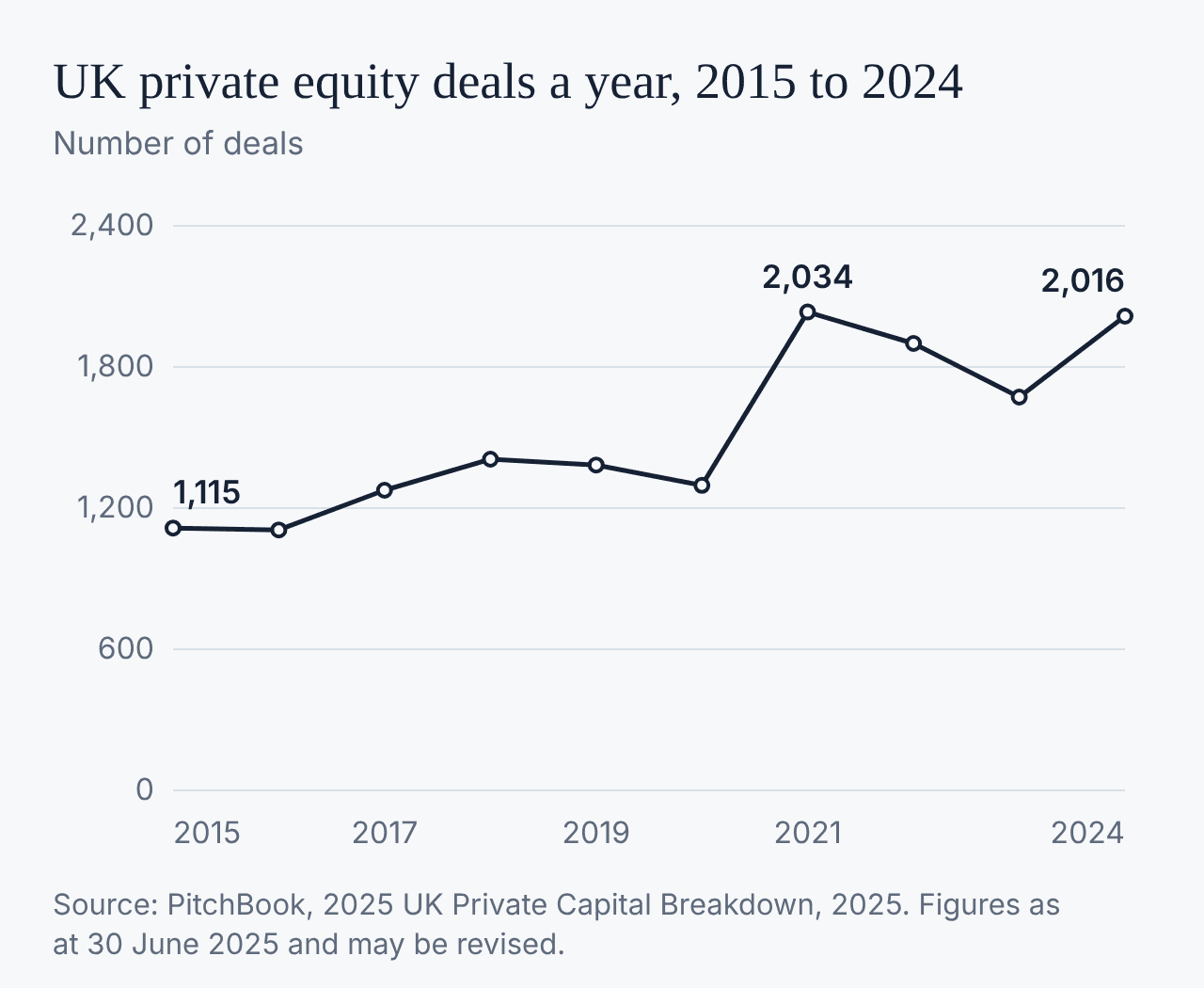
On PitchBook's count, the UK produced about 900 more private equity deals in 2024 than it did in 2015. The 2024 count was 18 below the 2021 peak.
The lower mid-market runs on direct conversations with owners
Lower mid-market is used here to mean companies that are large enough to attract a private equity fund or a trade buyer and are still owned and run by a founder or a family. That is our working description, and it sets no size band.
A founder who has run such a business for 25 years may have an accountant and a solicitor and may never have spoken to a corporate finance advisor. A company in that position appears on no list of businesses for sale, because nobody has been asked to sell it.
Screening on public signals has an obvious weakness here. Filed accounts and news coverage describe a company's past, and an owner's willingness to sell is recorded nowhere. Two companies with identical filings can have owners in opposite positions, one planning to hand the business to a daughter and the other privately hoping to retire within three years, and a buyer can only tell them apart by asking.
That is why direct origination at this size depends on conversations. The buyer, or someone acting for the buyer, contacts the owner, explains who is interested and why, and finds out whether a sale is possible and when. A conversation that ends in a polite refusal can still lead to a sale some years afterwards, because owners' circumstances change.
The share of UK deals that complete without a formal sale process is unknown, and so is the number of owner-managed companies that have no advisor. Figures quoted elsewhere for the off-market share should be treated with caution until their origin is clear.
A direct origination process has defined stages
Direct deal origination can be run as a repeatable process, and it has five stages.
It begins with criteria. The buyer sets out sector, geography, size, ownership and anything that would rule a company out, which produces a written specification that every target can be tested against.
Mapping follows, with the aim of listing every company that meets the specification. Completeness matters because a company missing from the list will never receive an approach. The third stage is the approach to the owner, for example by letter or telephone, and what it produces is conversations.
Owners who respond are then qualified, which means asking about their timing and their expectations on value. The count that matters at this fourth stage is the number of confidentiality agreements signed. Last comes the introduction, in which a qualified owner and the buyer hold a first meeting.
The output of each stage can be counted, which lets a buyer see where opportunities are being lost. Typical response rates and conversion rates for this kind of process in the UK are another gap in the published evidence, so none are given here.
Firms resource origination in three ways
A buyer can build an in-house origination team, rely on its partners and their advisor relationships, or engage a specialist firm.
An in-house team gives the buyer the most control over which companies are approached and how the firm is presented. It also carries a fixed cost in salaries whether deals complete or stall. Reliance on partners and advisors adds little cost, though coverage then extends only as far as the partners' time and contacts reach. A specialist firm charges fees for its work and can extend coverage beyond the buyer's own contacts. In exchange, the buyer accepts that a third party makes the first contact with owners on its behalf.
Gompers, Kaplan and Mukharlyamov reported that smaller and younger private equity firms source a larger share of proprietary deals. They suggested the pattern probably reflects the smaller deals those firms pursue, and the paper attaches no figure to the finding in its text. The cost of the three options has not been compared in any study we found. A firm could also combine them.
Funds are holding companies for longer while unspent capital ages
Bain's Global Private Equity Report 2026 puts global dry powder, the capital that funds have yet to invest, at $1.3tn and describes it as ageing. Most of it was raised in the 2022 and 2023 fund vintages.
Worldwide, exit value rose 47% in 2025 to $717bn, Bain reports, while the number of exits slipped 2% to 1,570. The industry still holds 32,000 unsold companies worth $3.8tn. Buyout funds are now holding companies for about seven years before exit, against an average of five to six years between 2010 and 2021. Almost 40% of companies have been held for more than five years, up from 29% in 2019.
Our reading of those figures is that they add to the demand for origination. Ageing capital still needs companies to buy, and one way to prepare a long-held company for sale is to add bolt-ons to it. KPMG's count shows that bolt-ons made up 59% of UK private equity deals in 2025.
