Deal origination
UK buy-and-build platforms should source bolt-ons across the whole hold
A platform would need 300 to 600 potential targets for six bolt-ons if one or two in 100 close, as Bain estimated in 2017. A search that size starts from the integration thesis and depends on how well owners are approached.
Bolt-on acquisitions made up 59% of all UK private equity deals in 2025, according to KPMG UK, which counted 1,751 deals in all. KPMG does not publish a bolt-on count, but 59% of 1,751 comes to roughly 1,000 deals.
A bolt-on is an acquisition by a company the fund already owns. That company is known as the platform, and US usage calls the acquisition an add-on. A buy-and-build strategy strings several bolt-ons together over one holding period.
UK writing covers the financing and legal execution of private equity buy-and-build in some depth and says far less about where the targets come from. That is often where a programme slows. Bolt-on acquisition sourcing is a branch of deal origination with its own arithmetic, and this piece looks at the routes to targets and at how an integration thesis becomes a programme of owner approaches.
A buy-and-build thesis repeats the search many times
A platform deal is one search with one outcome. A buy-and-build thesis needs a sequence of acquisitions, and each one starts a search of its own.
Those sequences have grown longer. In its 2019 analysis of buy-and-build, Bain & Company used global PitchBook data to show that in 2003, 21% of bolt-on deals were at least the platform's fourth acquisition. In the years before the report, the share was closer to 30%, and one bolt-on in ten was at least the platform's tenth. The report's yearly data runs only to 2018.
Bolt-on targets are smaller and more numerous than platform companies, and their owners usually run them. Many sit below the size at which a broker or corporate finance house would run a sale process, so they never reach a teaser list. The point is a judgement because no published figure counts the companies below that line.
In a 2017 article, Bain estimated that a private equity firm closes only one or two of every 100 potential targets that enter its funnel. On that ratio, a platform would need somewhere between 300 and 600 potential targets to start from if its thesis called for six acquisitions.
Where UK bolt-on activity sat in 2025
KPMG found that bolt-ons remained the most common type of UK private equity deal in 2025. It also reported that the number of bolt-on deals was about 5% below its historical average, without saying which period that average covers.
KPMG gives no sector split for bolt-ons, so its sector figures describe all UK private equity deals. Business services remained the busiest sector, with 45% of deals, even though its deal volume fell by around 11%. KPMG says professional services and digital consulting led the sector, and that accountancy and IT firms were being combined into larger groups.
Industrials rose 49%, while technology, media and telecoms fell 24% and healthcare fell 28%.
Private capital investors backed more than 1,400 UK businesses in 2025, according to UK Private Capital, formerly the BVCA. Nine in ten of those companies employed 250 people or fewer, and 57% were based outside London. The figures include venture capital, so they describe the wider population of companies backed by private capital.
For a platform, a reasonable reading is that its bolt-on targets are also likely to be small and spread across the regions. That reading favours a systematic map of each segment, since London intermediaries would reach only part of a market spread this widely.
Get off-market deal flow in your sector.
We take one mandate per sector and geography, and approach owners before a broker does.
Book a call
The routes to bolt-on targets, and their limits
Intermediaries and sale processes bring prepared opportunities and an efficient route to completion. A marketed company attracts other bidders and is priced accordingly, and intermediaries are thinner in the size band where many bolt-ons sit.
The platform's own network is often the best early source of names, because the management team knows its competitors and suppliers, as well as its customers and former colleagues. Its reach stops at the people management already knows, and sourcing eats into the time the team has for running the business.
The sponsor's sector coverage draws on the deal team's own research and relationships in the segment. That coverage is usually deepest where the fund has invested before, and it competes with the team's other deals for time.
Direct approaches go to the owners of mapped companies who have not decided to sell. This route reaches the widest share of the segment, and its results depend heavily on how well each approach is made.
Inbound enquiries start to arrive from owners and their advisers once they know the platform is buying. They are useful, though the platform cannot control their timing or quality.
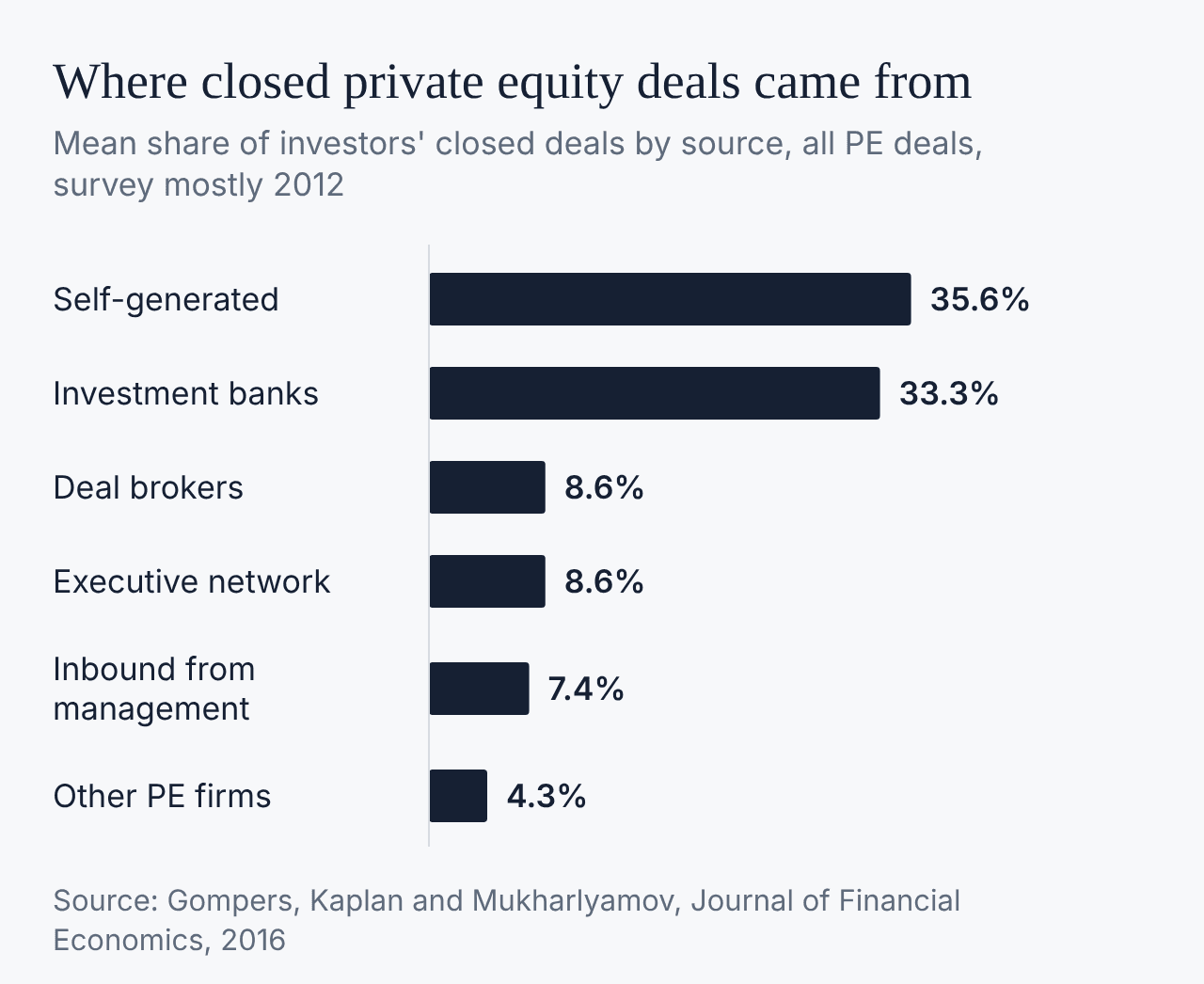
In general, private equity firms generate a large share of their own deals. In a survey published in the Journal of Financial Economics in 2016, Paul Gompers, Steven Kaplan and Vladimir Mukharlyamov found that investors described almost 36% of their closed deals as proactively self-generated, while 33% came from investment banks. Respondents regarded almost 48% of their closed deals as proprietary in some way, a claim the authors note they could not verify. Smaller and younger firms sourced more proprietary deals, which the authors link to smaller deal sizes.
The survey covers private equity deals of all kinds and has no UK breakdown, and most responses date from 2012. It still shows that self-generated sourcing is ordinary practice. A separate piece covers proprietary deal sourcing in more depth.
The integration thesis sets the target criteria
A bolt-on earns its place through what the platform can absorb, so the criteria come from the integration thesis. They set out the geography and capabilities the platform wants to add and the size of company it can integrate. They also define what rules a company out.
The map should then include every company that meets the criteria, including those whose owners show no sign of selling. Some owners change their plans later in the hold, and a full map already has their companies on it.
Companies House is the usual starting register, though it says little about how a small company trades. Under the current rules, small companies do not have to file a profit and loss account at Companies House. From April 2028 they will have to deliver one, but they can opt out of having it published. For that reason, mapping a segment depends on sources beyond the register, including the platform's own knowledge of its market.
Sponsor and platform management should agree the criteria before any outreach starts. The two sides lose time and can damage the relationship if they are still debating a target after its owner has engaged.
Owners who decline in year one may sell in year three
A programme can run across the whole hold and reach owners as their circumstances change. Bain's Global Private Equity Report 2026 puts the average holding period at exit for buyout funds at around seven years, against five to six years over 2010 to 2021. Buyout funds now hold almost 40% of their companies for more than five years, up from 29% in 2019. The figures are global and exclude bolt-ons. They show only that a typical hold leaves time for repeated approaches.
For direct approaches to owners, the response depends on who makes contact. A platform chief executive speaks to an owner as one operator to another, which carries credibility and costs management time. The sponsor shows the owner the financial backing behind the platform, though its approaches can lapse when the deal team is busy with other transactions. A third party can keep the buyer's name confidential until an owner shows interest. The catch is that an owner may give a stranger less time than a peer.
Conduct matters throughout. Approaches need discretion, and they should state the buyer's intent accurately. The buyer should not approach an owner again in a search the owner has turned down. In UK sectors of small companies, owners often know one another and tend to pass on news of a clumsy approach before the follow-up email arrives.
What 2026 programmes start from
KPMG counted 298 buyouts in 2025, the highest number since 2021, and a KPMG partner linked the rise to investors backing new platforms. It is reasonable to infer that many of those platforms will begin bolt-on programmes in 2026 and the years after. With bolt-ons already 59% of UK private equity deals, a platform will be best placed to complete them if it runs sourcing as a standing programme for the whole hold, with intermediated deals as one input among several.
