Business development
Business development for professional services needs to run all year
When the people who win new work are also the people who do it, business development needs clear decisions about where work comes from, who pursues it and how progress is measured.
In a professional services firm, the people who win new work are usually the people who then do it. A partner who lands an instruction on Monday is often the one delivering it by Friday. Clients are buying judgement and trust from named individuals, which makes business development for professional services hard to hand to someone else and easy to set aside when the diary fills.
This article treats the work as a set of decisions an established UK firm has to make. It defines the terms and looks at the shape of the UK sector and at how business buyers now choose suppliers. It then covers where new work comes from, who should do the work and how to tell whether it is working.
Lead generation is one stage of business development
A firm that hires a marketing executive and then waits for new instructions to follow has confused marketing with business development.
Marketing builds the firm's reputation and makes it easy to find. It covers the website, published thinking, events and the firm's presence in the places its clients look.
Lead generation produces a first conversation with a prospective client who fits the firm's criteria. In professional services, that usually means a meeting or call with someone who has the standing to instruct the firm.
Business development is the whole effort, from choosing which clients to pursue to winning the instruction and growing the relationship afterwards. Lead generation for professional services firms is one stage within it, and marketing supports every stage.
A lead is only useful once it is qualified. A workable definition of a qualified lead is a prospect with a real need the firm can meet and the authority to instruct it, on a timescale that makes the conversation worth having. Without that definition, a firm ends up counting meetings that were never going to produce work.
In UK professional services, the sellers are usually the doers
The UK had 427,755 businesses registered for VAT or PAYE in professional, scientific and technical activities in 2026, according to the Office for National Statistics. Of these, 92.8% had fewer than ten people in employment, a count that includes working owners and partners. Only 29,825 firms, or 7.0%, had between 10 and 249 people in employment, which is the size of firm this article has in mind.
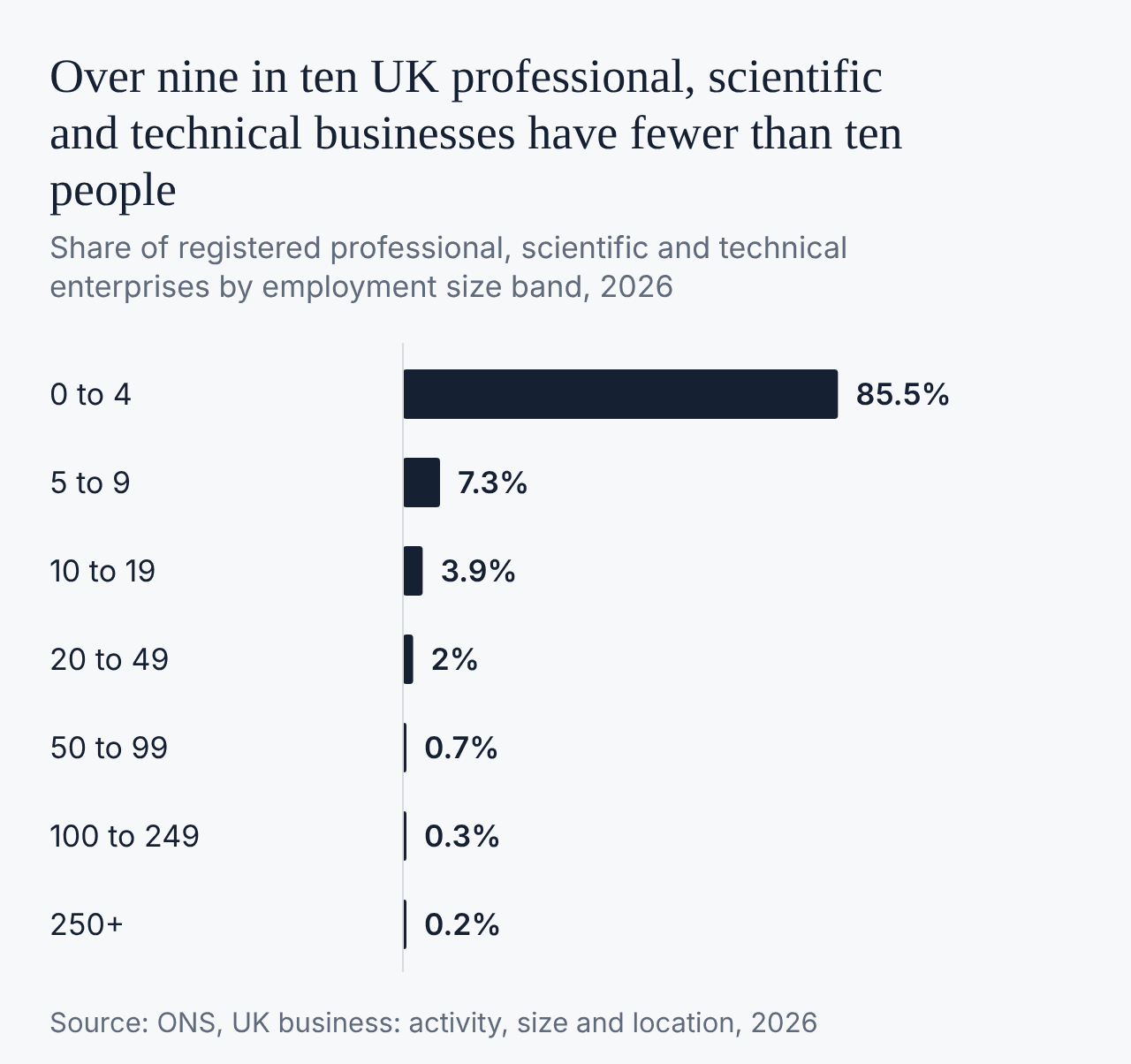
The pattern holds in the parts of the sector closest to this article's readers. In the same ONS release, 89.4% of legal and accounting firms and 90.6% of advertising and market research firms had fewer than ten people.
A firm of eight rarely has room for a dedicated business development role. The work falls to the owners and partners, who also carry the client load. A common result is a cycle in which business development stops when the firm is busy and restarts when work runs short. By the time new conversations begin, the gap in the pipeline has often already arrived.
Business buyers now spread their attention across many channels
McKinsey's B2B Pulse 2024 found that business buyers use an average of ten channels to deal with suppliers during a purchase, twice the five they used in 2016. At any stage of the buying journey, about a third prefer in-person contact, and the rest divide roughly evenly between remote contact and digital self-service. McKinsey reports that this split holds across regions and industries.
The research surveyed nearly 4,000 B2B decision makers in 13 countries and a wide range of sectors. McKinsey does not name the countries or sectors, so the findings describe business buyers in general and make no specific claim about UK professional services.
A firm that relies on a single route, whether referrals alone or its website alone, can reach only part of the buyers who might instruct it, and the evidence gives no reason to favour any one channel over the others.
Build a pipeline that doesn’t depend on referrals.
Every introduction is qualified in conversation before it reaches your team.
Book a call
New work comes from four routes, and each has limits
Referrals and work from existing clients form the highest-trust route, and for an established firm they are usually the largest. The firm controls neither the volume nor the timing, however, and a quiet year for its referrers becomes a quiet year for the firm. Depth of relationship matters on this route, because a client who knows several people at the firm and has seen its judgement on more than one problem has more reasons to come back and more occasions to mention the firm to others.
Introductions from other advisers and intermediaries, such as the accountant who points a client towards a solicitor, can be valuable. They work in both directions and are slow to build, because an adviser who makes an introduction puts their own reputation on the line.
Inbound enquiries come from people who find the firm when they start looking for an adviser. They arrive with a need already identified, which shortens the first conversation. They will usually compare several firms before choosing, so the firm enters a contest the moment the enquiry lands.
Outbound work means approaching organisations that fit the firm's criteria before they start looking. It reaches a much larger group who are not yet comparing suppliers. It also demands careful targeting and a respectful approach, and most of the organisations contacted will have no need for the firm at that moment.
The choice between these routes is a matter of mix. Before changing anything, a firm should be able to say roughly where its last year of new work came from, by route and by value. That answer usually shows how exposed the firm is to a single source.
Someone has to own the work, and each option has a cost
Partners and fee-earners are closest to the client and carry the most credibility in the room. They also have the least time, and every hour they give to business development is an hour away from billable work.
An in-house business development hire brings dedicated time and continuity. The ONS Annual Survey of Hours and Earnings puts the median gross annual pay of a full-time sales accounts and business development manager at £57,625 in April 2025. That figure is provisional and covers all sectors. Employer National Insurance and pension contributions come on top, as do recruitment costs. A new hire also needs time to learn the firm, and there is a risk that they generate conversations the partners do not follow up.
An outside firm brings speed and an existing method. It knows less about the firm and its clients at the start, so the arrangement needs clear criteria for what counts as a qualified introduction. Our piece on outsourced business development covers that decision in more detail.
Many firms combine these options, with partners looking after existing relationships while a hire or an outside firm opens new ones. Whatever the arrangement, the partners still have to turn the conversations into instructions. The handover from first conversation to partner meeting is where business development arrangements tend to succeed or fail.
Measure the steps that lead to instructions
Counts of calls made or events attended say little about whether new work is on its way. A short set of measures tells a firm far more.
Count the qualified first conversations held each month.
Track the share of those conversations that become proposals.
Record the instructions won and their value.
Measure the time from first conversation to instruction.
Compare the value of work won from new clients with the value won from existing ones.
Agree the qualification criteria before the work starts, so that everyone involved counts the same thing. Professional services buying cycles are often long, and a quarter is a short time over which to judge a new approach. Early measures will show conversations well before they show instructions.
In PwC's Law Firm Survey 2025, which covers the UK's 100 largest law firms, between 40% and 70% of firms said they were dissatisfied with the results of their organic growth initiatives across most measures. PwC notes that the fastest-growing firms tend to stand out for better execution, including targeted investment in business development and marketing teams. Execution is what the measures above track, from the first qualified conversation through to the instruction won.
Business development works best as a steady discipline
For an established firm, the work comes down to five decisions.
Decide which clients the firm wants to work for.
Choose the routes it will use to reach them.
Settle who does the work.
Define what a qualified opportunity looks like.
Agree how progress will be measured.
A firm that makes these decisions once and keeps to them through busy and quiet periods alike gives new work the best chance of arriving at a steady pace. A quiet quarter is a poor moment to start, because the conversations that would have filled it needed to begin months earlier.
